Fat Sources
Fat Sources for Dogs: What Actually Matters Beyond the Calorie Count
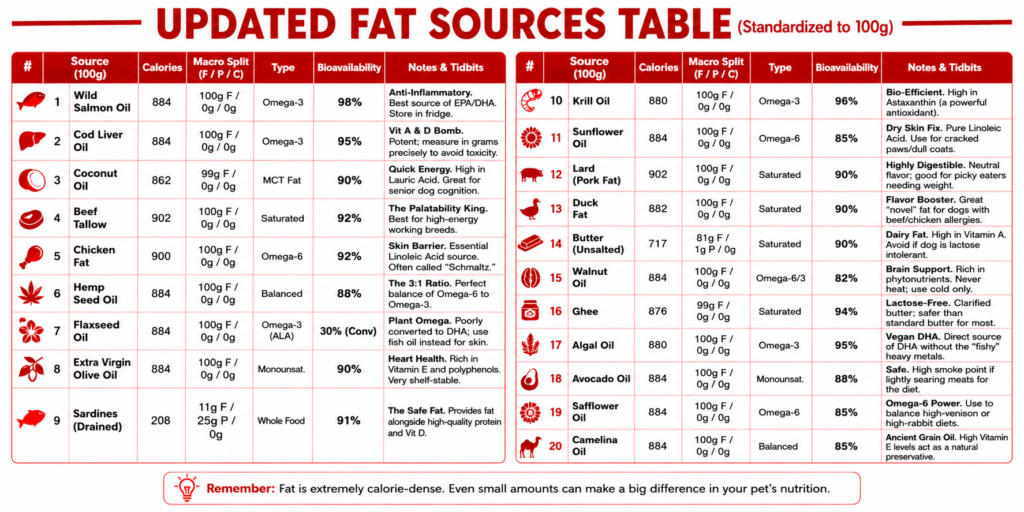
Fat is a dog’s most calorie-dense nutrient — more than double the energy per gram of protein or carbohydrate — and different fat sources do genuinely different jobs. Animal fats like chicken fat and beef tallow deliver energy and omega-6 fatty acids for skin barrier function. Marine sources (fish oil, salmon oil, krill oil) deliver EPA and DHA directly, in the form a dog’s body can actually use. Plant oils deliver ALA, a different and less directly useful omega-3, because dogs convert ALA into EPA/DHA at a rate low enough that flaxseed oil can’t really substitute for fish oil, despite how often the two get marketed as interchangeable. Coconut oil’s evidence is real but narrower than its reputation — the strongest data supports purified MCT oil for canine epilepsy, not whole coconut oil for the long list of things it’s often claimed to fix.
The omega-3 claim that doesn’t hold up the way people think
This is worth addressing directly, because it’s one of the more common points of confusion in dog nutrition, and it changes how you should actually think about several ingredients on this page.
Omega-3 fatty acids aren’t one thing. ALA (alpha-linolenic acid) is the short-chain omega-3 found in flaxseed, chia, hemp, and canola oil. EPA and DHA are the long-chain omega-3s found in fish, krill, and algae — and they’re the ones tied to the joint, skin, heart, and cognitive benefits people are usually looking for when they add an omega-3 to a dog’s diet. The problem is that a dog’s body has to convert ALA into EPA and DHA to use it that way, and that conversion runs through an enzyme (delta-6 desaturase) that’s the rate-limiting step in the whole pathway. In dogs, that conversion is genuinely inefficient — published research puts the ALA-to-DHA conversion rate at under 1% in most dogs, and a controlled comparison found that dogs supplemented with flaxseed oil showed higher ALA levels in their blood but no meaningful increase in EPA or DHA, while dogs given preformed EPA/DHA from a marine source saw a real increase in both.
None of this makes ALA useless — it’s still classified as an essential fatty acid because dogs can’t synthesize it themselves, and it appears to play a role in skin barrier function on its own. But it does mean flaxseed oil and fish oil aren’t interchangeable the way a lot of ingredient labels imply. If joint support, coat quality tied to inflammation, or cognitive support is the actual goal, a marine source is doing something flaxseed oil structurally can’t.
Ten fat sources, and what each one is actually good for
Animal fats
Chicken fat and pork fat (lard) both center on omega-6 linoleic acid, which is essential for skin barrier integrity — not something to avoid, despite omega-6 sometimes getting cast as the “bad” fatty acid in oversimplified omega ratio talk. Chicken fat is also one of the more palatable and digestible options on this list, which is part of why it shows up so often in commercial formulas. Lard specifically brings a balanced, monounsaturated-leaning profile and tends to be well tolerated.
Beef tallow is the most heat-stable of the animal fats here, largely saturated and monounsaturated, which makes it a reasonable steady-energy option for working dogs rather than a functional-nutrient play the way fish oil is.
Marine fats
Fish oil, salmon oil, and krill oil all deliver EPA and DHA directly, but they’re not identical. Fish oil and salmon oil are triglyceride-form omega-3s and are the most commonly used, cost-effective way to hit an EPA/DHA target. Krill oil delivers its omega-3s bound to phospholipids rather than triglycerides, which several comparative studies suggest improves absorption — the tradeoff is that krill oil is typically more expensive and delivered in smaller doses, so it’s often chosen for dogs needing high bioavailability in a small volume rather than as a default first option.
Salmon specifically needs to be fully cooked before it’s fed or before oil is extracted from raw material in a home setting — raw salmon can carry a parasite that causes a genuinely dangerous illness in dogs, unrelated to the fat content itself but worth flagging every time salmon comes up.
Plant oils
Flaxseed oil delivers ALA, and given the conversion problem above, it’s best understood as a modest, standalone skin-support ingredient rather than a fish oil substitute. Sunflower oil and canola oil both lean on omega-6 (sunflower more heavily, canola with a more balanced omega-6/omega-3 ratio), and both function more as economical, general-purpose fat sources than as targeted functional ingredients.
Coconut oil deserves its own explanation, because the evidence here is more specific than its popular reputation suggests. The strongest published research — including a multicenter randomized controlled trial and studies in veterinary epilepsy journals — supports purified medium-chain triglyceride (MCT) oil for reducing seizure frequency in dogs with idiopathic epilepsy. That’s a real, published finding. But whole coconut oil is only around 45-55% lauric acid and isn’t the same product as the purified MCT oil used in those trials, and claims about coconut oil’s antimicrobial or antifungal effects are currently supported mostly by lab-dish (in vitro) studies rather than trials in actual dogs. It’s not that coconut oil is useless — it’s that the specific, well-supported benefit (seizure frequency, via MCTs) is narrower than the general “great for skin, coat, digestion, and immunity” pitch it usually gets.
The pancreatitis question, without the oversimplified version
If you’ve read anything about feeding fat to dogs, you’ve run into the warning that high-fat diets cause pancreatitis. That advice isn’t baseless, but it’s more complicated than the blanket statement usually lets on.
A single high-fat meal — the classic “dog got into the trash” or “dog ate a plate of holiday leftovers” scenario — is a well-established trigger, and dietary indiscretion consistently shows up as a real risk factor across veterinary research. What’s less settled is whether a consistently higher-fat diet, fed as part of a complete and balanced formulation, carries the same risk. A narrative review published in the Journal of the American Veterinary Medical Association in late 2025 found that the classic studies linking dietary fat to pancreatitis relied on experimental models, small sample sizes, and diets that don’t reflect how dogs are actually fed today — and more recent work has generally failed to confirm a straightforward, consistent relationship between total dietary fat and pancreatitis risk in otherwise healthy dogs.
The more defensible takeaway: sudden fat spikes and low-protein, poorly formulated high-fat diets are the pattern worth actually worrying about — not a well-balanced diet that happens to run moderately higher in fat for an active or working dog. If a dog has already had a pancreatitis episode, fat restriction remains the standard, conservative approach your vet will likely recommend regardless of how the broader research shakes out, since a known-sensitive pancreas is a different situation than a healthy one.
One storage detail worth knowing: fat goes rancid
Unlike protein, dietary fat degrades with exposure to heat, light, and oxygen — a process called oxidation, or rancidity — and rancid fat isn’t just less effective, it can actively generate free radicals that increase a dog’s antioxidant needs. This is part of why vitamin E requirements climb specifically in diets that are higher in polyunsaturated fats like fish oil: those fats are more oxidation-prone, and vitamin E is what helps protect them (and the dog’s cells) from that damage. Practically, this means fat sources — especially fish and flaxseed oil — should be stored cold, sealed, and used within the timeframe on the label, not treated like a pantry staple with an indefinite shelf life.
Full reference table (per 100g of fat source)
| Fat Source | Type | Primary Fatty Acid Focus | Primary Benefit | Calories |
|---|---|---|---|---|
| Chicken Fat | Animal | Omega-6 (Linoleic Acid) | Essential for skin barrier and a glossy coat | ~900 kcal |
| Fish Oil | Marine | Omega-3 (EPA/DHA) | Anti-inflammatory; supports joints and heart health | ~900 kcal |
| Salmon Oil | Marine | Omega-3 (DHA) | Critical for cognitive function and retinal development | ~900 kcal |
| Beef Tallow | Animal | Saturated / Monounsaturated | Highly stable; sustained energy for working dogs | ~902 kcal |
| Flaxseed Oil | Plant | Omega-3 (ALA) | Plant-based skin support; poorly converted to EPA/DHA | ~884 kcal |
| Pork Fat (Lard) | Animal | Monounsaturated (Oleic) | Highly palatable and digestible; balanced profile | ~902 kcal |
| Coconut Oil | Plant | MCTs (Lauric Acid) | Best-supported for seizure frequency (as purified MCT oil) | ~862 kcal |
| Sunflower Oil | Plant | Omega-6 (Linoleic Acid) | Economical source for skin barrier support | ~884 kcal |
| Canola Oil | Plant | Omega-3 & Omega-6 | Balanced, economical general-purpose fat | ~884 kcal |
| Krill Oil | Marine | Phospholipid Omega-3s | Higher bioavailability per gram than standard fish oil | ~900 kcal |
How we use this at Build The Better Bowl
We treat “omega-3” as two different nutrients wearing the same name, not one interchangeable ingredient category — a plan that needs EPA/DHA for joint or cognitive support gets a marine source, not a flaxseed substitute that looks similar on a label but doesn’t function the same way in a dog’s body. We also don’t apply a blanket low-fat rule by default; total fat gets set based on the dog’s actual activity level and health history, with real fat restriction reserved for dogs who’ve had a diagnosed pancreatitis episode rather than applied preemptively to every plan.
Frequently asked questions
Is flaxseed oil a good substitute for fish oil in a dog’s diet? Not really, despite how often they’re marketed similarly. Flaxseed oil provides ALA, a short-chain omega-3 that dogs convert into the more biologically active EPA and DHA at a very low rate — often cited at under 1%. Fish oil, salmon oil, and krill oil provide EPA and DHA directly, in the form a dog’s body actually uses for joint, heart, and cognitive support.
Does coconut oil actually help dogs? The best-supported benefit is a reduction in seizure frequency for dogs with idiopathic epilepsy, and that evidence specifically involves purified MCT oil rather than whole coconut oil. Many of the other commonly claimed benefits, like antimicrobial or antifungal effects, are currently based on lab-dish studies rather than trials in actual dogs, so the evidence is real but narrower than coconut oil’s broader reputation suggests.
Does a high-fat diet cause pancreatitis in dogs? The clearest, most consistent risk factor is a sudden high-fat event, like a dog eating table scraps or getting into the trash, not a consistently higher-fat diet that’s complete, balanced, and introduced gradually. Recent veterinary research has found the evidence linking total dietary fat percentage to pancreatitis risk in healthy dogs to be weaker and more complicated than the traditional blanket warning suggests. Dogs with a pancreatitis history are still generally managed on a lower-fat diet as a precaution.
Why does fish oil need to be refrigerated? Fat oxidizes, or goes rancid, with exposure to heat, light, and air, and polyunsaturated fats like fish oil are especially prone to this. Rancid fat isn’t just less beneficial; it can generate free radicals that increase a dog’s need for antioxidants like vitamin E, so proper cold storage matters more for fish and flaxseed oil than it does for a more stable fat like beef tallow.
What’s the difference between fish oil, salmon oil, and krill oil? All three deliver EPA and DHA, the active long-chain omega-3s. Fish oil and salmon oil deliver them in triglyceride form and are typically the most cost-effective options. Krill oil delivers omega-3s bound to phospholipids, which several studies suggest improves absorption, generally at a higher price point and smaller per-dose volume.
Sources
- National Research Council. Nutrient Requirements of Dogs and Cats. National Academies Press, 2006.
- Peer-reviewed comparative studies on ALA-to-EPA/DHA conversion efficiency and omega-3 index response in dogs (Veterinary Medicine and Science; Today’s Veterinary Practice)
- Published veterinary trials on MCT oil supplementation and canine idiopathic epilepsy (Veterinary Record; Journal of Veterinary Internal Medicine; Epilepsia)
- “High fat, high risk? Evaluating the strength of evidence linking dietary fat and pancreatitis in dogs,” Journal of the American Veterinary Medical Association, 2026
This page is for general educational purposes and isn’t a substitute for individualized guidance from your veterinarian, particularly for dogs with a history of pancreatitis, epilepsy, or other conditions where fat intake needs to be managed carefully.