All-In-One Nutrition Guide
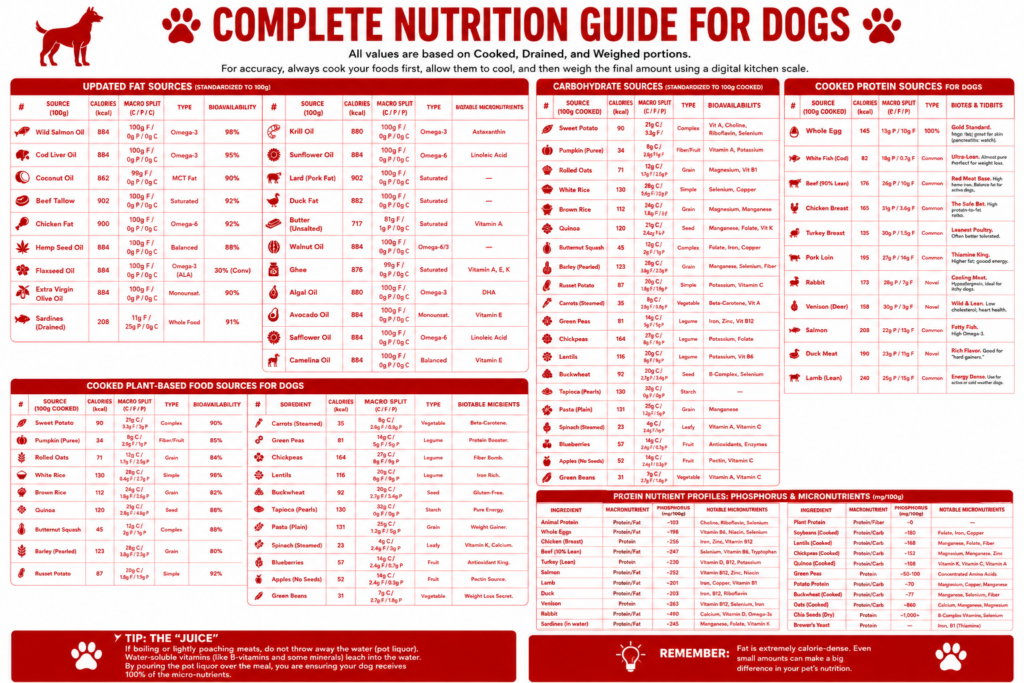
A balanced diet for a dog rests on four things working together: protein, fat, carbohydrates, and the micronutrients (like phosphorus, calcium, and a dozen vitamins and minerals) that quietly determine whether everything else actually adds up. This guide puts the nutrition data for 51 real, whole-food ingredients in one place — calories, macros, bioavailability, and micronutrient content — so you can understand exactly what each ingredient brings to the table. Understanding the ingredients is the first half of the picture. Turning that understanding into an actual, correctly balanced plan for your specific dog’s weight, life stage, and health needs is the harder half, and it’s exactly what our full video walkthrough and Build The Better Bowl program are built to handle.
Why nutrition data alone isn’t the same as a diet plan
It’s worth being upfront about something most ingredient charts don’t say out loud: knowing what’s in chicken breast, brown rice, and fish oil is genuinely useful — and it’s also only the starting material, not the finished plan. Four dogs of different sizes, life stages, and activity levels eating the exact same ingredients in the exact same proportions would end up with four very different nutritional outcomes, some of them meaningfully out of balance.
That’s not a reason to avoid learning the ingredient data. It’s the reason we built this page the way we did: a genuinely complete reference for understanding your options, paired with an honest acknowledgment that turning “here’s what’s in these ingredients” into “here’s exactly what my dog should eat tonight” involves real calculation — energy needs, protein and fat targets scaled to your dog specifically, and a micronutrient check that most homemade feeding advice skips entirely. That calculation is the part we walk through in full in our video guide, and the part our program automates for you when you’re ready to build an actual plan.
Animal protein sources
Bioavailability — how efficiently a dog’s body actually absorbs and uses a protein — varies meaningfully across this list, from whole egg’s reference-standard 100% down to duck’s 84%. Chicken and turkey breast are common defaults for their high protein-to-fat ratio, though chicken is also one of the more frequent triggers in dogs with a poultry sensitivity. Rabbit, venison, and duck serve a different purpose as novel proteins, genuinely useful for a dog working through a suspected food sensitivity, since a dog’s immune system can only react to something it’s been repeatedly exposed to. Salmon needs one explicit caution: fully cooked, always — raw salmon can carry a parasite that causes a genuinely dangerous illness in dogs.
| Source (100g cooked) | Calories | Macro Split | Type | Bioavailability | Notes |
|---|---|---|---|---|---|
| Whole Egg | 145 | 13g P / 10g F | Common | 100% | The reference protein; watch fat in pancreatitis-prone dogs |
| White Fish (Cod) | 82 | 18g P / 0.7g F | Common | 94% | Near-pure protein |
| Beef (90% Lean) | 176 | 26g P / 10g F | Common | 92% | High heme iron |
| Chicken Breast | 165 | 31g P / 3.6g F | Common | 90% | Common allergen for some dogs |
| Turkey Breast | 135 | 30g P / 1.5g F | Common | 90% | Often tolerated better than chicken |
| Pork Loin | 195 | 27g P / 14g F | Common | 85% | High in thiamine |
| Rabbit | 173 | 28g P / 7g F | Novel | 88% | Traditionally hypoallergenic |
| Venison (Deer) | 158 | 30g P / 3g F | Novel | 86% | Very low cholesterol |
| Salmon | 208 | 22g P / 13g F | Common | 91% | Must be fully cooked |
| Duck Meat | 190 | 23g P / 11g F | Novel | 84% | Higher iron content |
| Lamb (Lean) | 240 | 25g P / 15g F | Common | 82% | Most calorie-dense of this group |
Carbohydrate and plant food sources
Dogs don’t have a strict dietary requirement for carbohydrates — the NRC doesn’t set a minimum for a healthy adult dog. Carbohydrates earn their place through fiber, digestibility, and specific micronutrients instead. White rice’s near-total digestibility makes it a common choice during GI upset, while pumpkin’s soluble fiber helps in both directions. Russet potato skin concentrates solanine and should be peeled and fully cooked, and spinach’s oxalate content is worth avoiding for dogs with a bladder or kidney stone history.
Peas, lentils, and chickpeas are worth a direct note: they’re the ingredients most consistently flagged in the FDA’s ongoing investigation into a possible link between legume-heavy diets and diet-related dilated cardiomyopathy — a statistical association, not a proven cause, but reason enough to use them thoughtfully rather than as a diet’s primary carbohydrate base.
| Source (100g cooked) | Calories | Macro Split (C/F/P) | Type | Bioavailability | Notes |
|---|---|---|---|---|---|
| Sweet Potato | 90 | 21g C / 3.3g F / 2g P | Complex | 90% | Must be cooked to digest well |
| Pumpkin (Puree) | 34 | 8g C / 2.9g F / 1g P | Fiber/Fruit | 85% | Helps constipation and loose stool |
| Rolled Oats | 71 | 12g C / 1.7g F / 2.5g P | Grain | 84% | Beta-glucans for immune support |
| White Rice | 130 | 28g C / 0.4g F / 2.7g P | Simple | 98% | Standard for GI upset |
| Brown Rice | 112 | 24g C / 1.8g F / 2.6g P | Grain | 82% | Higher phosphorus than white rice |
| Quinoa | 120 | 21g C / 2.8g F / 4.4g P | Seed | 88% | Contains all essential amino acids |
| Butternut Squash | 45 | 12g C / 2g F / 1g P | Complex | 88% | Low-calorie volume |
| Barley (Pearled) | 123 | 28g C / 3.8g F / 2.3g P | Grain | 80% | Steady energy source |
| Russet Potato | 87 | 20g C / 1.8g F / 1.9g P | Simple | 92% | Peel and fully cook |
| Carrots (Steamed) | 35 | 8g C / 2.8g F / 0.8g P | Vegetable | 75% | Beta-carotene for eye health |
| Green Peas | 81 | 14g C / 5g F / 5g P | Legume | 70% | Flagged in FDA’s DCM review |
| Chickpeas | 164 | 27g C / 8g F / 9g P | Legume | 65% | Can cause gas if overfed |
| Lentils | 116 | 20g C / 8g F / 9g P | Legume | 68% | Iron-rich |
| Buckwheat | 92 | 20g C / 2.7g F / 3.4g P | Seed | 82% | Grain-free despite the name |
| Tapioca (Pearls) | 130 | 32g C / 0g F / 0g P | Starch | 95% | Used in elimination diets |
| Pasta (Plain) | 131 | 25g C / 1.2g F / 5g P | Grain | 90% | Calorie-dense |
| Spinach (Steamed) | 23 | 4g C / 2.4g F / 3g P | Leafy | 60% | High oxalates |
| Blueberries | 57 | 14g C / 2.4g F / 0.7g P | Fruit | 85% | Antioxidant-rich |
| Apples (No Seeds) | 52 | 14g C / 2.4g F / 0.3g P | Fruit | 80% | Pectin firms up loose stools |
| Green Beans | 31 | 7g C / 2.7g F / 1.8g P | Vegetable | 70% | Low-calorie substitution option |
Fat sources
Marine oils (wild salmon, cod liver, krill, algal) deliver EPA and DHA directly. Plant oils like flaxseed provide ALA instead, which dogs convert to EPA/DHA at a genuinely low rate, so flaxseed functions more as standalone skin support than a fish oil substitute. Animal fats (chicken fat, tallow, lard, duck fat) center on omega-6 for skin barrier function and tend to be palatable, heat-stable calorie sources. Coconut oil’s best-supported evidence is narrower than its reputation — purified MCT oil for seizure frequency in epileptic dogs, specifically, not the broader list of benefits it’s often credited with.
| Source (per 100g) | Calories | Fat Content | Type | Bioavailability | Notes |
|---|---|---|---|---|---|
| Wild Salmon Oil | 884 | 100g F | Omega-3 | 98% | Best source of EPA/DHA |
| Cod Liver Oil | 884 | 100g F | Omega-3 | 95% | Very high in vitamins A & D |
| Coconut Oil | 862 | 99g F | MCT Fat | 90% | Best-supported for seizure frequency |
| Beef Tallow | 902 | 100g F | Saturated | 92% | Heat-stable, steady energy |
| Chicken Fat | 900 | 100g F | Omega-6 | 92% | Skin barrier support |
| Hemp Seed Oil | 884 | 100g F | Balanced | 88% | Favorable Omega-6 to Omega-3 ratio |
| Flaxseed Oil | 884 | 100g F | Omega-3 (ALA) | ~30% (converted) | Not a fish oil substitute |
| Extra Virgin Olive Oil | 884 | 100g F | Monounsaturated | 90% | Rich in vitamin E and polyphenols |
| Sardines (Drained) | 208 | 11g F / 25g P | Whole Food | 91% | Fat alongside protein and vitamin D |
| Krill Oil | 880 | 100g F | Omega-3 | 96% | High in astaxanthin |
| Sunflower Oil | 884 | 100g F | Omega-6 | 85% | For dry or cracked skin |
| Lard (Pork Fat) | 902 | 100g F | Saturated | 90% | Useful for dogs needing weight |
| Duck Fat | 882 | 100g F | Saturated | 90% | Option for beef/chicken-sensitive dogs |
| Butter (Unsalted) | 717 | 81g F / 1g P | Saturated | 90% | Avoid if lactose intolerant |
| Walnut Oil | 884 | 100g F | Omega-6/3 | 82% | Use cold only |
| Ghee | 876 | 99g F | Saturated | 94% | Gentler for lactose sensitivity |
| Algal Oil | 880 | 100g F | Omega-3 | 95% | Vegan DHA source |
| Avocado Oil | 884 | 100g F | Monounsaturated | 88% | High smoke point |
| Safflower Oil | 884 | 100g F | Omega-6 | 85% | Balances high-venison or -rabbit diets |
| Camelina Oil | 884 | 100g F | Balanced | 85% | Natural preservative properties |
Phosphorus and micronutrients
Phosphorus swings from essentially zero (every fat and oil in this guide) to over 1,000 mg per 100g (brewer’s yeast), and that range genuinely matters for aging or kidney-sensitive dogs. In dogs with chronic kidney disease, damaged kidneys lose the ability to excrete phosphorus efficiently, and the resulting buildup accelerates the disease it’s a symptom of — which is why the International Renal Interest Society publishes specific phosphorus targets by CKD stage, and why therapeutic renal diets are formulated with meaningfully restricted phosphorus.
Brewer’s yeast and chia seeds are the densest phosphorus sources on this page. Brown rice carries notably more phosphorus than white rice. And fats and oils, at essentially zero phosphorus, become a genuinely useful tool for maintaining calories on a phosphorus-restricted plan. None of this changes anything for a healthy dog with normal kidney function — it’s a therapeutic consideration for a specific situation, not a general rule.
Carbohydrate & plant sources — phosphorus and micronutrients (per 100g)
| Ingredient | Macronutrient | Phosphorus | Notable Micronutrients |
|---|---|---|---|
| Sweet Potato | Complex Carb | 21 mg | Choline, Riboflavin, Selenium |
| Pumpkin (Puree) | Fiber/Fruit Carb | 8 mg | Vitamin A, Potassium |
| Rolled Oats | Grain Carb | 12 mg | Magnesium, Vitamin B1 |
| White Rice | Simple Carb | 28 mg | Selenium, Copper |
| Brown Rice | Grain Carb | 24 mg | Magnesium, Manganese |
| Quinoa | Seed Carb | 21 mg | Manganese, Folate, Vitamin K |
| Butternut Squash | Complex Carb | 12 mg | Folate, Iron, Copper |
| Barley (Pearled) | Grain Carb | 28 mg | Manganese, Selenium, Fiber |
| Russet Potato | Simple Carb | 20 mg | Potassium, Vitamin C |
| Carrots (Steamed) | Vegetable Carb | 8 mg | Vitamin A (Beta-carotene) |
| Green Peas | Legume Carb | 14 mg | Iron, Zinc, Vitamin B12 |
| Chickpeas | Legume Carb | 27 mg | Potassium, Folate |
| Lentils | Legume Carb | 20 mg | Potassium, Vitamin B6 |
| Buckwheat | Seed Carb | 20 mg | B-Complex Vitamins, Selenium |
| Tapioca (Pearls) | Starch Carb | 32 mg | — |
| Pasta (Plain) | Grain Carb | 25 mg | Manganese |
| Spinach (Steamed) | Leafy Carb | 4 mg | Vitamin A, Vitamin C |
| Blueberries | Fruit Carb | 14 mg | Trace Enzymes, Antioxidants |
| Apples (No Seeds) | Fruit Carb | 14 mg | Pectin, Vitamin C |
| Green Beans | Vegetable Carb | 7 mg | Vitamin A (Beta-carotene) |
Protein sources — phosphorus and micronutrients (per 100g)
| Ingredient | Macronutrient | Phosphorus | Notable Micronutrients |
|---|---|---|---|
| Whole Eggs | Protein/Fat | ~198 mg | Vitamin B6, Niacin, Selenium |
| Chicken (Breast) | Protein | ~256 mg | Iron, Zinc, Vitamin B12 |
| Beef (10% Lean) | Protein/Fat | ~247 mg | Selenium, Vitamin B6, Tryptophan |
| Turkey (Lean) | Protein | ~230 mg | Vitamin D, B12, Potassium |
| Salmon | Protein/Fat | ~252 mg | Vitamin B12, Zinc, Niacin |
| Lamb | Protein/Fat | ~201 mg | Iron, Copper, Vitamin B1 |
| Duck | Protein/Fat | ~203 mg | Vitamin B12, Riboflavin |
| Venison | Protein | ~263 mg | Vitamin B12, Selenium, Iron |
| Rabbit | Protein/Fat | ~490 mg | Calcium, Vitamin D, Omega-3s |
| Sardines (in water) | Protein/Fat | ~245 mg | Manganese, Folate, Vitamin K |
| Soybeans (Cooked) | Protein/Carb | ~180 mg | Folate, Iron, Copper |
| Lentils (Cooked) | Protein/Carb | ~168 mg | Manganese, Folate, Fiber |
| Chickpeas (Cooked) | Protein/Carb | ~152 mg | Magnesium, Manganese, Zinc |
| Quinoa (Cooked) | Protein/Carb | ~108 mg | Vitamin K, Vitamin C, Vitamin A |
| Green Peas | Protein | ~50–100 mg | Concentrated Amino Acids |
| Potato Protein | Protein/Carb | ~70 mg | Magnesium, Copper, Manganese |
| Buckwheat (Cooked) | Protein/Carb | ~77 mg | Manganese, Selenium, Fiber |
| Oats (Cooked) | Protein/Carb | ~860 mg | Calcium, Manganese, Magnesium |
| Chia Seeds (Dry) | Protein | ~1,000+ mg | B-Complex Vitamins, Selenium |
| Brewer’s Yeast | Protein | — | Iron, B1 (Thiamine) |
What this chart won’t tell you (and why that’s on purpose)
Here’s the honest limitation of any ingredient reference, this one included: it tells you what’s in the food, not how much your specific dog needs. Two dogs at the same weight can have meaningfully different calorie, protein, and micronutrient needs depending on age, activity level, spay/neuter status, and health history — and the single most common failure point in homemade feeding isn’t picking a bad ingredient, it’s getting the underlying math wrong for the dog actually eating it. Calcium in particular deserves a mention here: it’s a nutrient that muscle-meat-based diets don’t naturally provide in the right amount relative to phosphorus, and getting that balance wrong is a real, documented risk rather than a minor detail.
We didn’t build this page to walk through that calculation step by step, because getting it right requires more than a formula — it requires knowing your dog’s specific numbers and checking them against a real nutrient target, which is exactly the process our full video walkthrough demonstrates and our Build The Better Bowl program automates for you.
Build your dog’s actual plan
This reference guide is genuinely useful on its own — as a way to understand what’s in your dog’s food, compare ingredient options, and recognize the handful of real safety considerations (calcium, phosphorus, legumes, liver, solanine) that matter most. Pair it with our full video walkthrough, which shows exactly how every piece of this chart fits into building an actual, balanced bowl for your dog. When you’re ready to go from understanding the ingredients to having a real plan calculated for your dog specifically, that’s what Build The Better Bowl’s program is for.
Frequently asked questions
Is this chart enough to build my dog’s full diet on its own? It’s a genuinely useful starting point for understanding ingredient nutrition, but translating it into an actual balanced plan requires calculations specific to your dog’s weight, life stage, and activity level, plus a calcium check that most homemade feeding advice skips. Our video walkthrough covers that full process, and our program calculates it automatically for your dog.
Why do peas, lentils, and chickpeas need extra caution? They’re the ingredients most consistently flagged in the FDA’s ongoing investigation into a possible link between legume-heavy diets and diet-related dilated cardiomyopathy. It’s a statistical association, not a proven cause, but reason enough to use them thoughtfully rather than as a diet’s primary base.
Is flaxseed oil a good substitute for fish oil? Not really. Flaxseed oil provides ALA, which dogs convert to the more biologically active EPA and DHA at a very low rate. Fish oil, salmon oil, and krill oil provide EPA and DHA directly.
Why does calcium matter so much in a homemade diet? Muscle meat, the typical base of a homemade diet, is naturally much higher in phosphorus than calcium. Without a deliberate calcium addition, the resulting ratio skews toward phosphorus, which is a documented cause of skeletal problems, particularly in growing puppies. Getting that balance right is one of the calculations our program handles for you.
Where can I see the full process for building a balanced bowl? Our video walkthrough covers the complete process end to end, from understanding ingredient data like what’s on this page to building an actual plan. It’s the best next step if you’re ready to go beyond the reference chart.
Sources
- National Research Council. Nutrient Requirements of Dogs and Cats. National Academies Press, 2006.
- U.S. Food & Drug Administration, “FDA Investigation into Potential Link between Certain Diets and Canine Dilated Cardiomyopathy”
- International Renal Interest Society (IRIS), CKD staging and treatment recommendations
- Reference values compiled from Build The Better Bowl’s internal ingredient database
This page is for general educational purposes and isn’t a substitute for individualized guidance from your veterinarian or a board-certified veterinary nutritionist, particularly when formulating a complete diet for a puppy, a pregnant or nursing dog, or a dog with an existing health condition.