Phosphorus Content
Phosphorus in Dog Food Ingredients: A Full Reference by Category
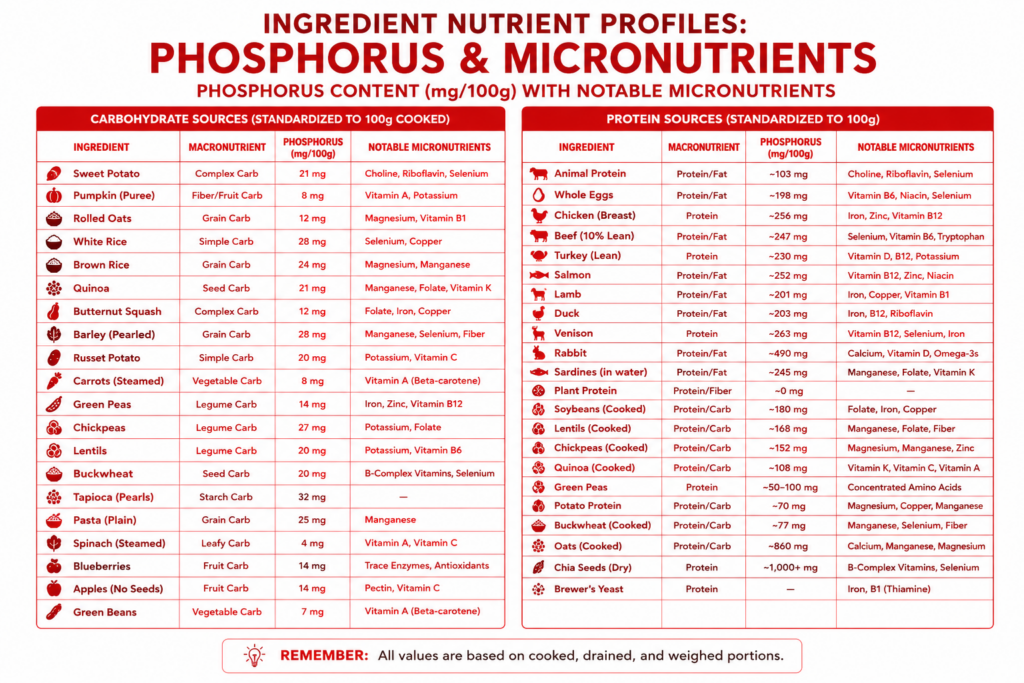
Phosphorus content varies enormously by ingredient category. Fats and oils carry essentially none (close to 0 mg per 100g), carbohydrates run low (roughly 4–103 mg per 100g), and protein sources run consistently higher, from about 150 mg per 100g up to sardines at roughly 490 mg per 100g — the highest of any whole-food ingredient on this list, driven by their edible bones. Brewer’s yeast and chia seeds are the real outliers, at 860 mg and over 1,000 mg per 100g respectively. This matters beyond simple nutrition trivia: phosphorus restriction is one of the few dietary interventions with real evidence behind it for slowing chronic kidney disease progression in dogs, and knowing which everyday ingredients are quietly phosphorus-dense is the difference between a renal-support diet that works and one that undermines itself.
Why phosphorus gets its own page
We’ve touched on phosphorus before, on our NRC micronutrients page, mostly in the context of the calcium-to-phosphorus ratio and healthy skeletal development. This page is a different angle on the same mineral: not the ratio, but the raw amount, ingredient by ingredient, and why that number matters more for some dogs than almost anything else on a nutrition label.
Here’s the clinical reason it deserves its own page. In dogs with chronic kidney disease, damaged kidneys lose the ability to excrete phosphorus efficiently, and the resulting buildup doesn’t just sit there quietly. Elevated blood phosphorus triggers a cascade — increased parathyroid hormone release, calcium pulled out of bone, and mineral deposits forming in soft tissue, including the kidneys themselves — that actively accelerates the disease it’s a symptom of. Multiple veterinary studies have found that dietary phosphorus restriction can meaningfully slow that progression, and the International Renal Interest Society (IRIS), the body that sets staging guidelines vets use for canine CKD, publishes specific serum phosphorus targets by stage precisely because hitting them is tied to real outcomes, not just a number on a lab report.
That’s the case for knowing this ingredient by ingredient rather than trusting a single “healthy” or “unhealthy” label. A lot of genuinely excellent whole-food ingredients — sardines, chia seeds, brewer’s yeast, even chicken breast — carry meaningfully more phosphorus than people assume, and that’s a fine thing to know for a healthy dog and a genuinely important thing to know for one managing kidney disease.
The clinical targets, for context
IRIS doesn’t set a target for dietary phosphorus directly — it sets targets for blood (serum) phosphorus, which diet is the primary lever for controlling:
| CKD Stage | IRIS Target Serum Phosphorus |
|---|---|
| Stage 2 | Below 4.5–4.6 mg/dL |
| Stage 3 | Below 5.0 mg/dL |
| Stage 4 | Below 6.0 mg/dL |
To hit those targets, therapeutic renal diets are typically formulated to around 0.2–0.5% phosphorus on a dry-matter basis — meaningfully lower than a standard adult maintenance diet. This is exactly why kidney-specific commercial diets exist as their own category rather than dogs with CKD simply eating less of a normal food: the phosphorus density of the ingredients themselves has to come down, not just the portion size.
None of this is a substitute for veterinary guidance — CKD staging, phosphate binder decisions, and diet transitions all need a vet’s involvement — but understanding which ordinary ingredients are quietly phosphorus-heavy is genuinely useful context going into that conversation.
Phosphorus by ingredient (mg per 100g)
Animal protein
| Source | Phosphorus (mg/100g) | Notable Micronutrients |
|---|---|---|
| Sardines (in water) | ~490 mg | Calcium, Vitamin D, Omega-3s |
| Rabbit | ~263 mg | Vitamin B12, Selenium, Iron |
| Chicken (Breast) | ~256 mg | Vitamin B6, Niacin, Selenium |
| Salmon | ~252 mg | Vitamin D, B12, Potassium |
| Beef (10% Lean) | ~247 mg | Iron, Zinc, Vitamin B12 |
| Venison | ~239 mg | Vitamin B12, Riboflavin |
| Turkey (Lean) | ~230 mg | Selenium, Vitamin B6, Tryptophan |
| Duck | ~203 mg | Iron, Copper, Vitamin B1 |
| Lamb | ~201 mg | Vitamin B12, Zinc, Niacin |
| Whole Eggs | ~198 mg | Choline, Riboflavin, Selenium |
Sardines are the clear standout here, and it’s not a processing artifact — it’s the edible bone content, the same reason sardines show up as a calcium source. That combination (high phosphorus alongside high calcium) is a genuinely different nutritional profile than a boneless muscle cut, and worth factoring in separately from “just another fish.”
Plant protein
| Source | Phosphorus (mg/100g) | Notable Micronutrients |
|---|---|---|
| Brewer’s Yeast | ~1,000+ mg | B-Complex Vitamins, Selenium |
| Chia Seeds (Dry) | ~860 mg | Calcium, Manganese, Magnesium |
| Soybeans (Cooked) | ~245 mg | Manganese, Folate, Vitamin K |
| Lentils (Cooked) | ~180 mg | Folate, Iron, Copper |
| Chickpeas (Cooked) | ~168 mg | Manganese, Folate, Fiber |
| Quinoa (Cooked) | ~152 mg | Magnesium, Manganese, Zinc |
| Green Peas | ~108 mg | Vitamin K, Vitamin C, Vitamin A |
| Potato Protein | ~50–100 mg | Concentrated Amino Acids |
| Oats (Cooked) | ~77 mg | Manganese, Selenium, Fiber |
| Buckwheat (Cooked) | ~70 mg | Magnesium, Copper, Manganese |
Brewer’s yeast and chia seeds are worth calling out specifically, because both are commonly added to diets in small amounts as “boosters” — for palatability and B vitamins in yeast’s case, for omega-3s and protein in chia’s — without much thought to their phosphorus contribution. Per 100g they’re the densest phosphorus sources on this entire list, but the amounts typically used are small enough that it rarely matters for a healthy dog. It’s worth actually doing that math, though, rather than assuming a “just a sprinkle” ingredient is automatically phosphorus-negligible.
Carbohydrates
| Source | Phosphorus (mg/100g) | Notable Micronutrients |
|---|---|---|
| Brown Rice | ~103 mg | Magnesium, Selenium, B3 |
| Pasta (Cooked) | ~58 mg | Selenium, Folate |
| Sweet Potato | ~47 mg | Vitamin A (Beta-carotene) |
| White Rice | ~43 mg | Manganese |
| Oatmeal | ~77 mg | B-Vitamins, Iron |
| Barley | ~75 mg | Selenium, Copper |
| White Potato | ~70 mg | Potassium, Vitamin B6 |
| Butternut Squash | ~33 mg | Vitamin A, Vitamin E, Potassium |
| Pumpkin | ~30 mg | Vitamin A, Potassium |
| Bananas | ~22 mg | Pectin, Vitamin C |
| Tapioca (Cassava) | ~7 mg | Potassium, Vitamin C |
| Honey | ~4 mg | Trace Enzymes, Antioxidants |
This is where the kidney-diet planning gets genuinely practical: brown rice carries meaningfully more phosphorus than white rice, which is exactly why a lot of renal-support formulations default to white rice over brown despite brown rice’s usual fiber and micronutrient advantages. Tapioca and honey sit at the opposite end — close to phosphorus-free — which is part of why tapioca in particular shows up so often in both kidney-support and food-elimination diets: it’s about as metabolically “quiet” a carbohydrate as exists.
Fats and oils
| Source | Phosphorus (mg/100g) | Notable Micronutrients |
|---|---|---|
| Animal Fats (Tallow/Lard/Chicken) | ~0 mg | Vitamin E, Choline (trace) |
| Marine Oils (Fish/Salmon/Krill) | ~0 mg | EPA/DHA, Vitamin D, Astaxanthin (Krill) |
| Plant Oils (Flax/Sun/Canola/Coconut) | ~0 mg | Vitamin E, Vitamin K |
This is genuinely useful, not just a rounding-error footnote. Fat is calorie-dense and essentially phosphorus-free, which makes it one of the few practical tools for keeping total calories and body condition stable in a dog on a phosphorus-restricted diet without leaning harder on phosphorus-dense protein to hit an energy target. It’s a big part of why therapeutic renal diets tend to run moderately higher in fat than standard maintenance formulas — not as a general health strategy, but as a specific, deliberate way to solve the “adequate calories, restricted phosphorus” problem at the same time.
How we use this at Build The Better Bowl
For any plan involving an aging dog, a dog with early-stage kidney values worth watching, or a dog already on a vet-directed renal protocol, phosphorus density gets checked ingredient by ingredient rather than assumed from a food category. That means white rice over brown when phosphorus matters, sardines used deliberately rather than defaulted to, and fat used intentionally as a low-phosphorus calorie source when a dog needs to maintain weight on a more restricted plan. For healthy dogs with no kidney concerns, none of this changes anything about how we’d normally build a plan — phosphorus restriction is a therapeutic tool for a specific situation, not a general wellness practice.
Frequently asked questions
Why does phosphorus matter so much for dogs with kidney disease? Damaged kidneys lose the ability to excrete phosphorus efficiently, and the resulting buildup triggers a cascade that includes increased parathyroid hormone release, calcium loss from bone, and mineral deposits in soft tissue, including the kidneys themselves. This actively accelerates disease progression, which is why phosphorus restriction is one of the few dietary interventions with real evidence behind it for slowing canine CKD.
What is the phosphorus target for a dog with chronic kidney disease? The International Renal Interest Society (IRIS) sets serum phosphorus targets by CKD stage: below 4.5–4.6 mg/dL for Stage 2, below 5.0 mg/dL for Stage 3, and below 6.0 mg/dL for Stage 4. Therapeutic renal diets are typically formulated to around 0.2–0.5% phosphorus on a dry-matter basis to help hit those targets, well below a standard maintenance diet.
Which everyday dog food ingredients are surprisingly high in phosphorus? Sardines (around 490 mg per 100g, due to their edible bones), brewer’s yeast (over 1,000 mg per 100g), and chia seeds (around 860 mg per 100g) are the standouts. Brown rice also carries meaningfully more phosphorus than white rice, which is worth knowing since the two are often treated as interchangeable.
Are fats and oils a good option for a phosphorus-restricted diet? Yes, functionally. Fats and oils carry essentially no phosphorus, which makes them a useful way to maintain total calories and body condition in a dog on a phosphorus-restricted diet without depending on phosphorus-dense protein sources to hit an energy target. This is part of why therapeutic renal diets often run moderately higher in fat than standard maintenance formulas.
Should a healthy dog with no kidney issues worry about phosphorus intake? Generally, no. Phosphorus restriction is a therapeutic strategy for dogs with diagnosed or developing kidney disease, not a general wellness practice for healthy dogs. A healthy dog’s kidneys excrete excess phosphorus efficiently, and the NRC’s recommended allowance already accounts for normal phosphorus needs across a typical diet.
Sources
- International Renal Interest Society (IRIS), CKD staging and treatment recommendations
- National Research Council. Nutrient Requirements of Dogs and Cats. National Academies Press, 2006.
- Peer-reviewed veterinary literature on dietary phosphorus restriction and CKD progression in dogs (Journal of the American Veterinary Medical Association; Today’s Veterinary Practice)
- Reference values compiled from Build The Better Bowl’s internal ingredient database
This page is for general educational purposes and isn’t a substitute for individualized veterinary guidance, particularly for dogs with diagnosed or suspected chronic kidney disease. Phosphorus restriction, phosphate binder use, and renal diet transitions should always be directed by a veterinarian.