Mirconutrient Recommendations
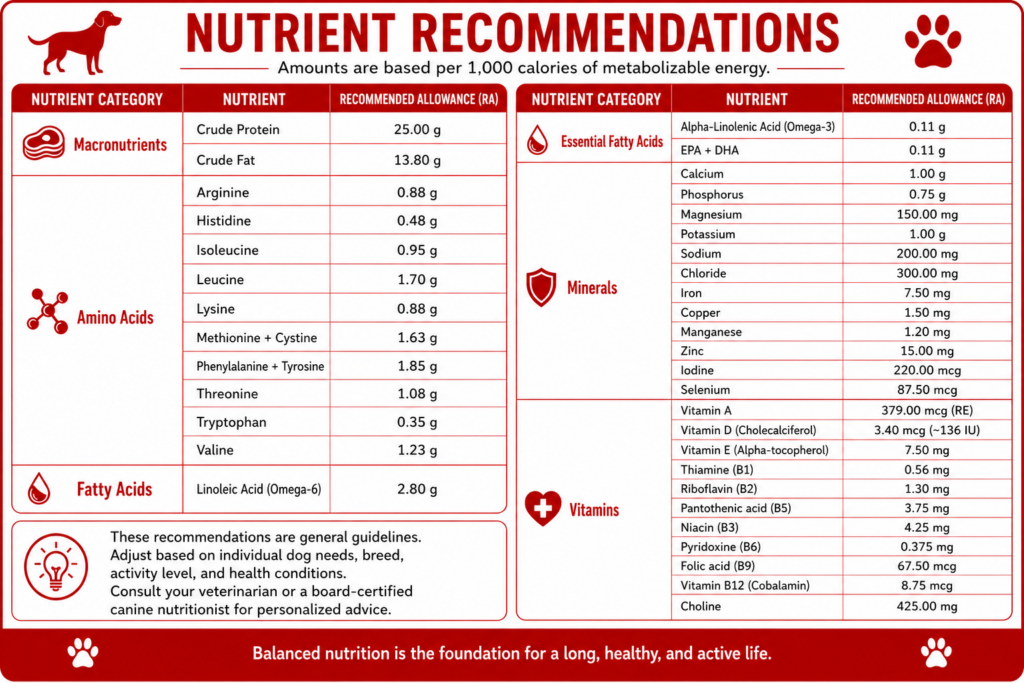
Micronutrients are the minerals and vitamins a dog needs in small amounts but can’t function without — twelve minerals and eleven vitamins, according to the NRC’s Nutrient Requirements of Dogs. Unlike protein and fat, where “more is generally fine,” several of these have a real ceiling: too much vitamin D, for example, has triggered multiple FDA recalls and can cause kidney failure, and too much zinc can induce a copper deficiency even when copper intake looks adequate on paper. Getting the total gram amount right matters less than getting the ratios right — calcium to phosphorus, zinc to copper — which is where most home-prepared diets actually go wrong.
Why micronutrients get overlooked (and why that’s a mistake)
Protein and fat are easy to picture. You can look at a chicken breast and have a rough sense of what it’s contributing. Micronutrients don’t work that way — nobody’s intuition tells them how many milligrams of zinc are in a sweet potato, and the amounts involved are small enough that it’s easy to assume they’ll just “work themselves out” if the rest of the diet looks reasonable.
They won’t. The NRC treats vitamins and minerals as individually essential, with their own recommended allowances, because a dog’s body can’t substitute one for another the way it can swap fat and carbohydrate for calories. A diet that’s short on manganese doesn’t get fixed by adding more chicken. And a handful of these nutrients — vitamin D chief among them — are dangerous in excess, not just in deficiency, which is the opposite of how most people think about vitamins.
Minerals: the ratio matters more than the raw number
Macrominerals — calcium, phosphorus, magnesium, potassium, sodium, chloride
Calcium and phosphorus get more attention than the other four combined, and for good reason: the ratio between them, not just the individual amounts, determines whether a growing puppy builds a normal skeleton or a fragile one. The NRC’s recommended allowance works out to roughly 1.33 grams of calcium for every gram of phosphorus, which lands inside the 1.2–1.4:1 range that veterinary nutrition sources generally consider optimal for dogs.
Skew that ratio too far in either direction and you get real problems, not theoretical ones. Diets built almost entirely around boneless muscle meat run heavy on phosphorus and light on calcium — this is a known cause of nutritional secondary hyperparathyroidism in large-breed puppies, and severe enough cases have caused pathological bone fractures. Go too far the other direction with excess calcium supplementation, and you can interfere with the absorption of zinc and other trace minerals instead. Neither mistake is rare in home-prepared diets built without a way to check the actual numbers, which is a big part of why “just add some bone meal” isn’t real feeding advice.
Sodium, chloride, magnesium, and potassium round out the macromineral list. They’re less prone to dramatic imbalance in a normal fresh-food diet, but they’re still individually essential — magnesium in particular plays a role in enzyme function and muscle activity that a lot of home-prepared plans quietly under-deliver on, since it isn’t a headline nutrient the way calcium is.
Trace minerals — iron, copper, manganese, zinc, iodine, selenium
These are needed in tiny amounts, and that’s exactly what makes them easy to get wrong in both directions. Zinc is the clearest example: it’s essential for skin integrity, wound healing, and coat quality, but feeding it too generously can suppress copper absorption badly enough to cause a copper deficiency even when the diet technically contains “enough” copper. The two minerals compete for absorption in the gut, and zinc consistently wins that fight when it’s oversupplied. The visible result — a dull, dry coat with patchy pigment loss — actually looks similar whether the underlying problem is too little zinc or too much of it relative to copper, which is exactly why guessing at supplementation is a bad strategy here.
Iron, manganese, iodine, and selenium each carry their own essential job — iron in oxygen transport, iodine in thyroid hormone production, selenium as part of the body’s antioxidant defense system — but the practical lesson across all six trace minerals is the same one: named organ meats (liver especially) and whole animal proteins tend to deliver these in the ratios nature already balanced, which is a lot more forgiving than trying to hit six individual mineral targets with a supplement aisle.
Vitamins: where “more is better” stops being true
Fat-soluble vitamins — A, D, and E
Fat-soluble vitamins get stored in the body’s fat tissue and liver rather than flushed out in urine the way water-soluble vitamins are, and that storage capability is exactly what makes vitamin D worth taking seriously.
This isn’t a hypothetical risk. Between 2018 and 2019, the FDA tracked and issued recalls against more than a dozen dry and canned dog food brands — including major, well-known names — after testing found vitamin D levels as much as 70 times higher than intended, traced back to a formulation error at a shared contract manufacturer. Dogs that ate the affected food showed vomiting, loss of appetite, excessive thirst, and in serious cases, kidney failure. It’s one of the more sobering reminders in commercial pet food history that “essential nutrient” and “safe in any amount” are not the same claim, and it’s a big part of why we’re cautious about stacking multiple vitamin D sources (fish body oils, cod liver oil, and a fortified base all at once, for instance) in any plan we help build.
Vitamin A carries a similar fat-soluble caution, though less dramatically, while vitamin E functions largely as an antioxidant and works in tandem with selenium — diets high in fish oil and other polyunsaturated fats actually increase the vitamin E requirement, since those fats are more prone to oxidation and use up antioxidant reserves faster.
Water-soluble vitamins — the B-complex and choline
The B vitamins (thiamine, riboflavin, niacin, pantothenic acid, pyridoxine, folic acid, and B12) are a lower-drama category by comparison, mostly because excess amounts are excreted rather than stored. That doesn’t make them optional — thiamine deficiency in particular can cause neurological symptoms and has been linked historically to diets heavy in raw fish containing thiaminase, an enzyme that destroys thiamine before the dog can use it.
Choline deserves its own mention, since it doesn’t fit neatly into the “vitamin” or “mineral” bucket but shows up on every NRC nutrient table alongside them. It supports liver function and cell membrane integrity, and at 425 mg per 1,000 kcal, it’s actually required in a larger amount than most of the vitamins on this list combined.
The full NRC micronutrient table (per 1,000 kcal ME)
| Category | Nutrient | Recommended Allowance |
|---|---|---|
| Macrominerals | Calcium | 1.00 g |
| Phosphorus | 0.75 g | |
| Magnesium | 150.00 mg | |
| Potassium | 1.00 g | |
| Sodium | 200.00 mg | |
| Chloride | 300.00 mg | |
| Trace minerals | Iron | 7.50 mg |
| Copper | 1.50 mg | |
| Manganese | 1.20 mg | |
| Zinc | 15.00 mg | |
| Iodine | 220.00 mcg | |
| Selenium | 87.50 mcg | |
| Fat-soluble vitamins | Vitamin A | 379.00 mcg (RE) |
| Vitamin D (cholecalciferol) | 3.40 mcg (~136 IU) | |
| Vitamin E (alpha-tocopherol) | 7.50 mg | |
| Water-soluble vitamins | Thiamine (B1) | 0.56 mg |
| Riboflavin (B2) | 1.30 mg | |
| Niacin (B3) | 4.25 mg | |
| Pantothenic acid (B5) | 3.75 mg | |
| Pyridoxine (B6) | 0.375 mg | |
| Folic acid (B9) | 67.50 mcg | |
| Vitamin B12 (cobalamin) | 8.75 mcg | |
| Other essential nutrient | Choline | 425.00 mg |
These are Recommended Allowances for a healthy adult dog at maintenance. Growth, pregnancy, lactation, and certain medical conditions shift several of these numbers — calcium and phosphorus in particular increase notably during growth and reproduction.
How we use this at Build The Better Bowl
Every plan we build checks against this full micronutrient list, not just the headline protein and fat numbers — because a diet that “looks complete” on protein and calories can still be quietly short on zinc, or running a calcium:phosphorus ratio that’s fine on paper but wrong in practice once you factor in what a specific cut of meat or organ actually contributes. We also flag the nutrients where the risk runs the other direction, like vitamin D, so you’re not stacking multiple fortified sources without realizing it.
Frequently asked questions
What’s the ideal calcium to phosphorus ratio for dogs? Most veterinary nutrition sources put the optimal range at 1.2:1 to 1.4:1 (calcium to phosphorus), with AAFCO’s broader acceptable range running from 1:1 to 2.1:1. The NRC’s own recommended allowance (1.00g calcium to 0.75g phosphorus per 1,000 kcal) works out to about 1.33:1, right in the middle of that target zone.
Can dogs get too much vitamin D? Yes, and it’s more than a theoretical concern — multiple commercial dog foods have been recalled by the FDA after testing found vitamin D levels dozens of times higher than intended, with affected dogs developing symptoms ranging from vomiting and excessive thirst to kidney failure. Because vitamin D is fat-soluble and stored in the body rather than excreted, excess intake builds up over time instead of washing out.
Does too much zinc cause a copper deficiency in dogs? It can. Zinc and copper compete for absorption in the gut, and oversupplying zinc — through supplementation or an imbalanced diet — can induce a functional copper deficiency even when dietary copper looks adequate on paper. The visible signs (dull coat, pigment loss) can look similar for both a zinc deficiency and a zinc-induced copper deficiency, which is why guessing at mineral supplementation tends to backfire.
Which minerals and vitamins increase during pregnancy and lactation? Calcium and phosphorus requirements rise notably during growth, pregnancy, and lactation to support skeletal development and milk production. Overall energy and several B vitamin needs climb as well, since a lactating dam’s metabolic rate can reach several times her maintenance level by peak lactation.
Is it possible to get all of this right with whole foods, or do I need supplements? Both, realistically. Whole animal proteins, organ meats, and fish cover most of the trace mineral and B-vitamin picture reasonably well, but a handful of nutrients — calcium being the most common gap in home-prepared diets built around boneless meat — usually require a deliberate addition rather than showing up naturally in the right amount.
Sources
- National Research Council. Nutrient Requirements of Dogs and Cats. National Academies Press, 2006.
- U.S. Food & Drug Administration, “Vitamin D Toxicity in Dogs” and related recall advisories
- Merck Veterinary Manual, “Nutritional Requirements of Small Animals”
- Association of American Feed Control Officials (AAFCO) Nutrient Profiles