Carbohydrates Sources
Carbohydrate Sources for Dogs: The Complete Breakdown
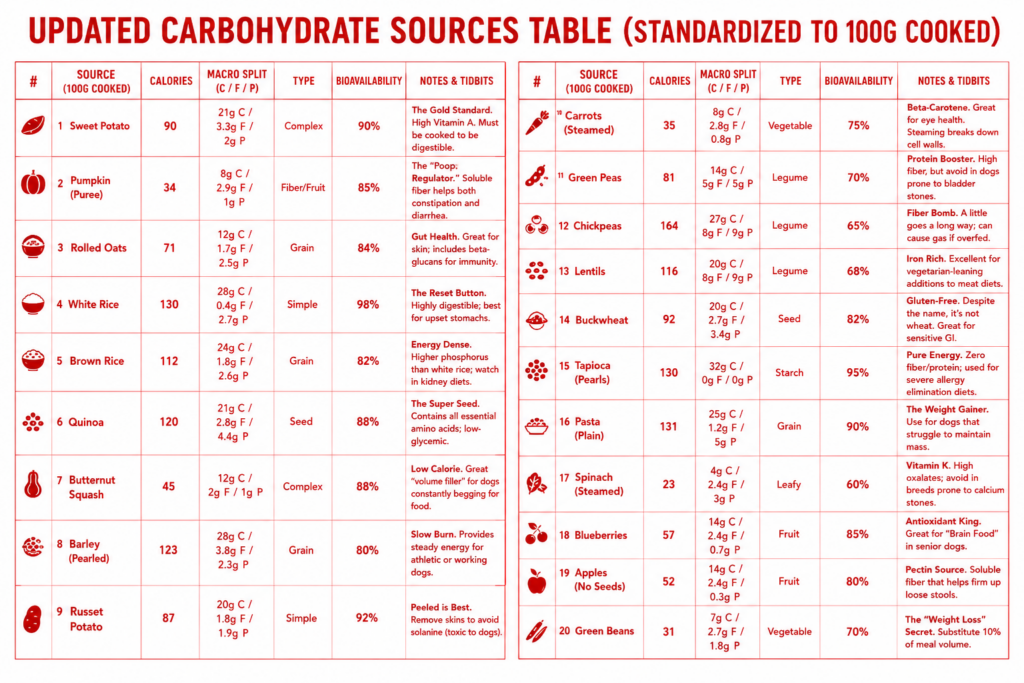
Dogs don’t have a strict dietary requirement for carbohydrates the way they do for specific amino acids and fatty acids — the NRC doesn’t list a minimum carbohydrate requirement for healthy adult dogs, though puppies and pregnant or lactating dogs are the exception, since glucose demand climbs during growth and milk production. That said, “not required” isn’t the same as “not useful.” Twenty common carbohydrate sources — grains, root vegetables, legumes, fruit, and leafy greens — range from about 23 to 164 calories per 100g cooked, and they earn their place in a diet through fiber, digestibility, and specific micronutrients rather than through any essential-nutrient obligation. A few, including potato skins, spinach, and legumes fed in excess, come with real caveats worth knowing rather than glossing over.
Do dogs actually need carbohydrates?
This is worth settling upfront, because it changes how you should think about every ingredient below. Dogs can synthesize glucose from protein and fat through a process called gluconeogenesis, which is why the NRC doesn’t classify dietary carbohydrate as an essential nutrient for a healthy, non-reproducing adult dog the way it does for specific amino acids or fatty acids. Puppies and pregnant or lactating females are the exception — their glucose demand for growth and milk production is high enough that dietary carbohydrate becomes genuinely useful, not just optional.
For everyone else, carbohydrates earn their spot in a bowl on different merits: fiber for GI regulation, specific vitamins and antioxidants that come bundled with certain carb sources, easy calorie density for weight gain or maintenance, and, in some cases, genuine digestive gentleness during an upset stomach. None of that makes carbs harmful or unnecessary — it just means the conversation about how much and which ones is more about function than about hitting a required number, which is a genuinely different framing than protein or fat.
Roots, tubers, and squash: the everyday energy base
Sweet potato is the most nutrient-dense of the root vegetables here, carrying a strong beta-carotene (vitamin A precursor) load, but it needs to be cooked — raw sweet potato is genuinely hard for a dog to digest and largely wastes the nutrient content. Worth knowing: sweet potato is also one of the higher-oxalate root vegetables, which matters specifically for dogs with a history of calcium oxalate bladder stones, even though it’s an excellent ingredient for dogs without that history.
Russet potato, unlike sweet potato, belongs to the nightshade family and contains solanine — a compound concentrated in the skin, especially if it’s green or sprouted. Cooking reduces solanine levels significantly, and peeling removes most of what’s left, which is exactly why “peeled and fully cooked” isn’t a fussy suggestion here so much as the actual safety threshold.
Pumpkin puree earns its reputation as a genuine two-way digestive tool — its soluble fiber content can help firm up loose stool and ease mild constipation, which is a rare case of one ingredient meaningfully helping in both directions.
Butternut squash and carrots round out this group as lower-calorie, high-volume options — useful for dogs who beg constantly or need a lower-density way to feel fuller, and carrots specifically benefit from steaming, which breaks down plant cell walls and makes their beta-carotene more accessible than it is raw.
Grains and pseudograins: where digestibility varies the most
White rice stands out for one specific reason: extremely high digestibility, which is exactly why it’s the standard recommendation for dogs recovering from GI upset. Brown rice brings more fiber and nutrients than white rice, but it also runs higher in phosphorus, which is worth knowing if you’re managing a dog with kidney disease where phosphorus is being actively restricted.
Rolled oats are gentle, provide meaningful B vitamins, and contain beta-glucans — a type of soluble fiber increasingly studied for immune-supportive effects. Barley and pasta both function more as calorie-dense energy sources than functional ingredients — barley suits sustained energy needs for working or athletic dogs, while plain pasta is a genuinely useful, if unglamorous, tool for dogs that struggle to maintain weight.
Quinoa and buckwheat are technically seeds, not true grains, which matters for dogs on a grain-free or sensitive-GI protocol. Quinoa is notable for containing all essential amino acids on its own — a detail covered in more depth on our plant protein page — while buckwheat’s real-world value is its gentleness on sensitive digestive systems.
Tapioca pearls are the outlier of this category: essentially pure starch, with no meaningful fiber or protein. That makes tapioca nutritionally unremarkable on its own, but genuinely useful in a very specific context — elimination diets for dogs undergoing a food allergy workup, where a completely “blank” carbohydrate with nothing to react to is exactly the point.
Legumes: useful in moderation, worth reading the fine print on
Chickpeas, lentils, and green peas all bring real nutritional value — chickpeas and lentils in particular are genuinely useful iron and fiber sources, and lentils specifically work well as a partial substitute in more plant-forward or vegetarian-leaning additions to an otherwise meat-based diet.
Two things are worth being direct about here, though. First, legumes are dense enough in fiber that overfeeding them reliably causes gas and GI upset — chickpeas especially, where “a little goes a long way” isn’t an exaggeration. Second, peas and lentils are the exact ingredients most consistently associated with the FDA’s ongoing investigation into diet-related dilated cardiomyopathy (DCM) in dogs, a link that remains statistically notable but not proven causal — we cover the full nuance of that investigation on our plant protein page, but it’s worth repeating here: these are ingredients to use thoughtfully within a varied diet, not to lean on as a primary carbohydrate source.
Fruits and vegetables: real benefits, real exceptions
Blueberries carry a genuinely strong antioxidant profile and get reasonably called “brain food” for senior dogs, though that’s shorthand for supporting overall cognitive and cellular health rather than a guarantee against age-related decline. Apples (with seeds removed — apple seeds contain a compound that releases cyanide during digestion, in large enough quantities to matter) bring pectin, a soluble fiber that can help firm up loose stool similarly to pumpkin.
Green beans are a genuinely popular low-calorie substitution ingredient — swapping a portion of a meal’s regular volume for green beans is a common, reasonable strategy for dogs on a calorie-controlled weight loss plan, since it adds bulk and fiber without much caloric cost.
Spinach is the one ingredient on this list that deserves the most caution. It’s a real source of vitamin K, but it’s also one of the higher-oxalate vegetables a dog is likely to encounter, and oxalates are a known contributor to calcium oxalate bladder and kidney stones — a urolith type that’s become more common in dogs over the past several decades. For a healthy dog eating spinach occasionally, this isn’t a meaningful risk. For a dog with a history of calcium oxalate stones, or a breed with elevated genetic risk for them (Miniature Schnauzers, Bichon Frisés, Yorkshire Terriers, and Lhasa Apsos show up often in that conversation), spinach is worth skipping rather than working around.
Full reference table (per 100g, cooked, drained, and weighed)
| # | Source | Calories | Carbs | Fat | Protein | Category | Bioavailability | Notable For |
|---|---|---|---|---|---|---|---|---|
| 1 | Sweet Potato | 90 | 21g | 3.3g | 2g | Complex | 90% | High vitamin A; must be cooked to digest well |
| 2 | Pumpkin (Puree) | 34 | 8g | 2.9g | 1g | Fiber/Fruit | 85% | Soluble fiber; helps both constipation and loose stool |
| 3 | Rolled Oats | 71 | 12g | 1.7g | 2.5g | Grain | 84% | Beta-glucans for immune support |
| 4 | White Rice | 130 | 28g | 0.4g | 2.7g | Simple | 98% | Highly digestible; standard for GI upset |
| 5 | Brown Rice | 112 | 24g | 1.8g | 2.6g | Grain | 82% | More fiber than white rice; higher phosphorus |
| 6 | Quinoa | 120 | 21g | 2.8g | 4.4g | Seed | 88% | Contains all essential amino acids; low-glycemic |
| 7 | Butternut Squash | 45 | 12g | 2g | 1g | Complex | 88% | Low-calorie volume filler |
| 8 | Barley (Pearled) | 123 | 28g | 3.8g | 2.3g | Grain | 80% | Steady energy for working dogs |
| 9 | Russet Potato | 87 | 20g | 1.8g | 1.9g | Simple | 92% | Peel and fully cook to avoid solanine |
| 10 | Carrots (Steamed) | 35 | 8g | 2.8g | 0.8g | Vegetable | 75% | Beta-carotene for eye health |
| 11 | Green Peas | 81 | 14g | 5g | 5g | Legume | 70% | High fiber; part of the FDA’s DCM ingredient review |
| 12 | Chickpeas | 164 | 27g | 8g | 9g | Legume | 65% | Dense in fiber; can cause gas if overfed |
| 13 | Lentils | 116 | 20g | 8g | 9g | Legume | 68% | Iron-rich; good for plant-forward additions |
| 14 | Buckwheat | 92 | 20g | 2.7g | 3.4g | Seed | 82% | Grain-free (despite the name); gentle on sensitive GI |
| 15 | Tapioca (Pearls) | 130 | 32g | 0g | 0g | Starch | 95% | Pure starch; used in elimination diets |
| 16 | Pasta (Plain) | 131 | 25g | 1.2g | 5g | Grain | 90% | Calorie-dense; useful for weight gain |
| 17 | Spinach (Steamed) | 23 | 4g | 2.4g | 3g | Leafy | 60% | High oxalates; avoid with stone-prone breeds |
| 18 | Blueberries | 57 | 14g | 2.4g | 0.7g | Fruit | 85% | Antioxidant-rich; supports senior cognitive health |
| 19 | Apples (No Seeds) | 52 | 14g | 2.4g | 0.3g | Fruit | 80% | Pectin helps firm up loose stools |
| 20 | Green Beans | 31 | 7g | 2.7g | 1.8g | Vegetable | 70% | Low-calorie substitution for weight management |
How we use this at Build The Better Bowl
Carbohydrates get sized around function in the plans we build, not around a required minimum, since one largely doesn’t exist for a healthy adult dog. That means white rice earns a spot for a dog recovering from GI upset, pumpkin gets used specifically for its dual-direction fiber effect, and legumes get capped rather than featured as a primary carb source, both for the gas-and-GI-tolerance reason and out of the same caution we apply on our plant protein page regarding the ongoing DCM research. For dogs with a bladder or kidney stone history, spinach and excess sweet potato get flagged and adjusted before they ever make it into a plan.
Frequently asked questions
Do dogs need carbohydrates in their diet? Not in the same essential-nutrient sense as protein or fat — the NRC doesn’t set a minimum carbohydrate requirement for healthy adult dogs, since they can produce glucose from protein and fat. Puppies and pregnant or lactating dogs are the exception, with genuinely higher glucose demand. For everyone else, carbohydrates are more about fiber, digestibility, and specific nutrients than a required intake target.
Is it safe to feed a dog potato skins? Not recommended. Potato skins concentrate solanine, a compound that’s especially elevated in green or sprouted potatoes and can cause gastrointestinal or, in severe cases, neurological symptoms. Peeling potatoes and cooking them thoroughly meaningfully reduces this risk; sweet potatoes, notably, aren’t a nightshade and don’t carry the same solanine concern.
Why is spinach controversial for dogs? Spinach is high in oxalates, compounds that bind with calcium and can contribute to calcium oxalate bladder and kidney stones, a urolith type that’s become more common in dogs over recent decades. For most healthy dogs, occasional spinach isn’t a real concern, but it’s genuinely worth avoiding for dogs with a stone history or breeds with elevated genetic risk for calcium oxalate stones.
Are peas and lentils safe to feed dogs? In moderation, yes, and they bring real nutritional value. They’re also the specific ingredients most consistently flagged in the FDA’s ongoing investigation into a possible link between legume-heavy diets and diet-related dilated cardiomyopathy — a statistical association, not a proven cause. We treat them as ingredients to use thoughtfully within a varied diet rather than as a primary, standalone carbohydrate source.
What’s the best carbohydrate for a dog with an upset stomach? Plain white rice is the standard recommendation, largely because of its very high digestibility (around 98%) and low fiber and fat content, which puts minimal demand on a stressed digestive system. Pumpkin puree is a common complementary addition, specifically for its soluble fiber’s effect on stool consistency.
Sources
- Reference values compiled from Build The Better Bowl’s internal ingredient database of cooked, drained, and weighed carbohydrate sources
- National Research Council. Nutrient Requirements of Dogs and Cats. National Academies Press, 2006.
- U.S. Food & Drug Administration, “FDA Investigation into Potential Link between Certain Diets and Canine Dilated Cardiomyopathy”
- Published veterinary literature on canine calcium oxalate urolithiasis and dietary oxalate management
This page is for general educational purposes and isn’t a substitute for individualized guidance from your veterinarian, particularly for dogs with a history of bladder or kidney stones, kidney disease, or known food sensitivities.