Protein & Fat By Lifestage
NRC Fat & Protein Recommendations for Dogs
A Guide by Life Stage and Lifestyle
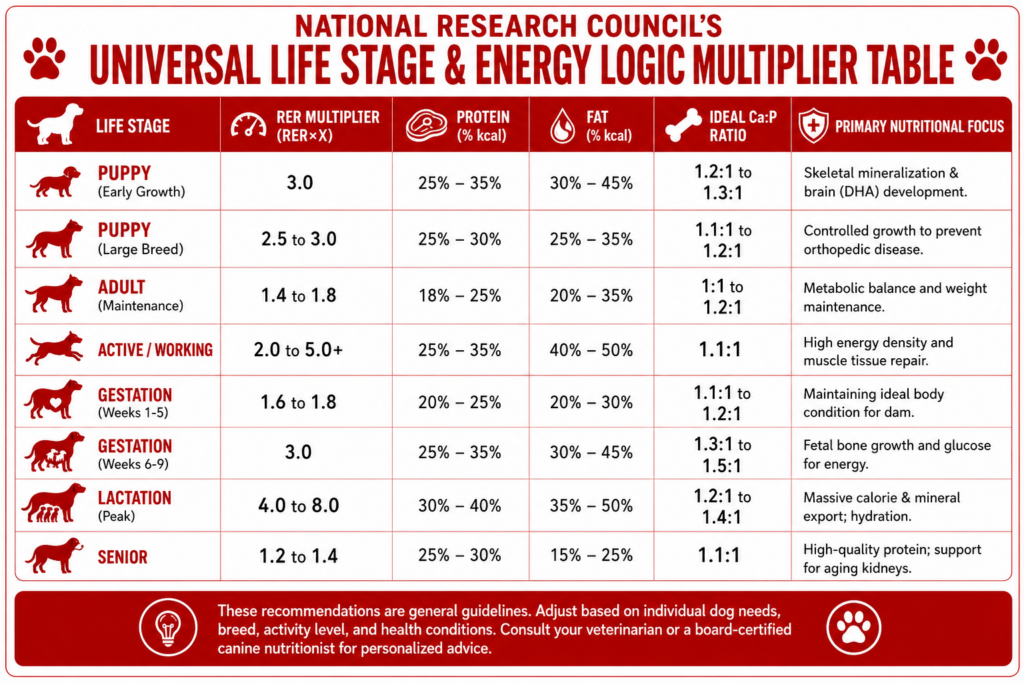
For a healthy adult dog at maintenance, the NRC’s Recommended Allowance is 25 grams of protein and 13.8 grams of fat per 1,000 kcal of metabolizable energy — roughly equivalent to a diet that’s 18–20% protein and 5.5% fat on a dry-matter basis, though most home-prepared and fresh diets run higher. Puppies, pregnant and nursing dogs, and working dogs all need meaningfully more than that baseline. The rest of this page breaks down exactly how much, and why the NRC numbers look so different from what you’ll see printed on a bag of kibble.
Why “NRC” and “AAFCO” aren’t the same thing
If you’ve spent any time comparing dog food labels, you’ve probably run into two different sets of numbers that don’t seem to agree with each other, and there’s a reason for that.
The National Research Council (NRC) publishes Nutrient Requirements of Dogs, the underlying scientific document that estimates how much of each nutrient a dog’s body actually needs to function — based on controlled feeding trials and metabolic research, not on what’s practical to manufacture. These are physiological minimums and recommended allowances, expressed per 1,000 kcal of metabolizable energy (ME), which is a fancy way of saying “per 1,000 calories the dog actually absorbs and uses.”
AAFCO (the Association of American Feed Control Officials) takes that NRC research and translates it into minimums that commercial pet food has to meet to legally carry a label like “complete and balanced.” AAFCO numbers build in a safety margin for ingredient variability and processing loss, which is why AAFCO minimums typically run a bit higher than the NRC’s baseline recommended allowance.
For anyone building a home-prepared, fresh, or supplemented diet — which is the whole reason we built Build The Better Bowl — the NRC numbers are the more useful starting point, because you’re working with known ingredients and known digestibility instead of formulating around processing losses you can’t see.
Protein & fat requirements by life stage
Nutrient needs aren’t static. A dog’s protein and fat requirements shift substantially across four broad windows: growth, adult maintenance, reproduction, and the senior years. Here’s how the NRC frames each one.
| Life Stage | Protein (NRC minimum/target) | Fat | What’s driving the number |
|---|---|---|---|
| Puppies, under 14 weeks | ~21% ME minimum (practical diets) | Higher fat needed for energy density and EFAs | Rapid tissue growth and a small stomach capacity mean every calorie has to work harder |
| Puppies, 14 weeks–adulthood | ~17.5–22% ME (AAFCO growth minimum is 22%) | 8–20% fat, dry-matter basis, in most commercial growth diets | Still building muscle and skeletal mass, but growth rate is slowing |
| Adult dogs, maintenance | 25 g protein / 1,000 kcal ME (NRC Recommended Allowance) | 13.8 g fat / 1,000 kcal ME | Tissue repair and maintenance rather than net-new growth |
| Pregnant (last third) & lactating dogs | Meaningfully above maintenance — commonly cited around 25%+ protein on a dry-matter basis at peak lactation | 21.3 g fat / 1,000 kcal ME (NRC minimum and recommended allowance) | A nursing dam’s energy needs can climb to 2–4x maintenance by weeks 3–4 of lactation, depending on litter size |
| Senior dogs | At or above adult maintenance — NRC does not set a lower protein target for seniors | Often moderated to manage weight and activity decline | Older dogs lose muscle mass (sarcopenia) more easily; restricting protein without a medical reason to do so tends to accelerate that, not prevent it |
A couple of things worth sitting with here. First, the NRC doesn’t actually publish a separate, lower “senior” protein requirement — that’s largely a commercial food marketing category, not a physiological one. Unless a vet has diagnosed a kidney or liver condition that specifically calls for protein restriction, most senior dogs do better maintaining or even slightly increasing protein intake to offset age-related muscle loss, while fat and total calories get dialed back to match a slower metabolism.
Second, notice how close the puppy minimums (21–22% ME) sit next to the pregnancy/lactation minimums. That’s not a coincidence — AAFCO actually uses the same “growth and reproduction” nutrient profile for both puppy food and food fed to pregnant or nursing dogs, because the metabolic demands overlap that closely.
Protein & fat requirements by lifestyle
Life stage tells you where a dog is developmentally. Lifestyle tells you how hard that dog’s body is working day to day — and the NRC actually has a formal way of accounting for that, through what it calls energy multipliers.
These multipliers scale a dog’s estimated daily energy requirement based on activity level, which in turn changes how much protein and fat they need in absolute terms (even if the “per 1,000 kcal” ratio stays similar):
| Lifestyle | NRC Energy Multiplier | What this looks like day to day |
|---|---|---|
| Sedentary / senior, low activity | ~70–90 | One or two short, easy walks a day; limited exertion |
| Moderately active (typical companion dog) | ~90–110 | Regular walks, some off-leash play, a normal pet lifestyle |
| Highly active / working / sporting dogs | ~110–130 | Hiking, running, agility, hunting, herding, or other sustained physical work |
| NRC standard reference dog | 130 | The baseline the published “per 1,000 kcal” tables are actually built around |
Here’s the part that trips a lot of people up: those “grams per 1,000 kcal” numbers in the life-stage table above only apply cleanly to a dog eating at the NRC’s standard 130 multiplier. A sedentary senior eating fewer total calories at a multiplier of 80 needs the nutrient density of their food to go up, not down — because they’re getting fewer calories overall but still need the same total grams of protein, amino acids, and minerals to maintain their body. This is one of the most common formulation mistakes we see in home-prepared diets: cutting calories for a less active or overweight dog without adjusting nutrient density to match, which quietly creates a protein or mineral deficiency even while the dog is stable or gaining weight.
Working and sporting dogs sit at the other end of the spectrum. Higher sustained energy output increases both caloric need and the case for fat as a primary fuel source — fat provides more than double the calories per gram of either protein or carbohydrate, which is exactly why working-dog and performance formulas tend to run noticeably higher in fat than a standard maintenance diet.
Why these specific numbers — the amino acid and fatty acid backbone
Total protein and total fat are the headline numbers, but they’re really just the container. What actually determines whether a diet is complete is what’s inside that protein and fat.
Dogs need ten essential amino acids they cannot synthesize on their own — arginine, histidine, isoleucine, leucine, lysine, methionine, phenylalanine, threonine, tryptophan, and valine — and the NRC sets recommended allowances for each of them individually, not just for “protein” as a lump sum. A diet can technically hit 25g of protein per 1,000 kcal and still fall short on lysine or tryptophan if the protein sources are poorly chosen or overly reliant on connective tissue and low-quality byproducts. This is the whole argument for building a diet around named, whole-food animal proteins rather than formulating to a single crude protein percentage.
The same logic applies to fat. The NRC’s recommended allowances distinguish between linoleic acid (an omega-6 fatty acid essential for skin barrier function), alpha-linolenic acid (a plant-based omega-3), and EPA/DHA (the long-chain marine omega-3s tied to joint, heart, and cognitive health). A diet can hit its total fat gram target using an ingredient that’s almost entirely omega-6 and still leave a dog short on the omega-3s that actually support coat quality and inflammation control — which is exactly why fish oil, salmon oil, or another EPA/DHA source shows up in nearly every well-formulated fresh or home-prepared plan.
How we use this at Build The Better Bowl
We built Build The Better Bowl because most home-cooked dog food advice online is either wildly oversimplified (“just feed 50/50 meat and veggies”) or buried in academic tables that aren’t written for a normal pet owner trying to make dinner. The NRC’s Recommended Allowances are the foundation of every plan we generate — life stage, activity level, and current body condition all adjust the target numbers before we ever suggest a single ingredient.
If you’re building a plan for a growing puppy, a working dog, a pregnant or nursing mother, or a senior who needs more protein density rather than less, the numbers above are the starting line. Matching them consistently, meal after meal, is the part that actually takes some work — which is the problem we set out to solve.
Frequently asked questions
How much protein does a dog need per day, in grams? It depends on the dog’s size and life stage, but as a starting point: a 30 kg (66 lb) adult dog eating around 1,300 kcal a day at NRC’s maintenance recommendation of 25g protein per 1,000 kcal needs roughly 32–33 grams of protein daily. Puppies, pregnant/nursing dogs, and highly active dogs need more, both because their target ratio is higher and because they’re often eating more total calories.
Is the NRC minimum enough, or should I feed above it? The NRC publishes both a minimum requirement (MR) and a recommended allowance (RA), and the RA already includes a margin above the bare minimum. Most fresh and home-prepared diets, including the plans we build, target at or somewhat above the RA rather than the minimum, since home diets don’t have the same fortification consistency as a processed commercial diet.
Do senior dogs need less protein? No — this is one of the most persistent myths in dog nutrition. The NRC does not publish a reduced protein target for healthy seniors. Unless a veterinarian has diagnosed a specific condition (like certain stages of kidney disease) that calls for protein restriction, older dogs generally benefit from maintaining or increasing protein to help offset natural, age-related muscle loss.
How is “percent ME” different from the percentage on a dog food bag? The percentage on a bag’s guaranteed analysis is usually measured on an “as fed” or dry-matter basis, not per calorie. Two foods with the same protein percentage on the label can deliver very different amounts of protein per calorie if their fat and moisture content differ. Comparing foods by grams per 1,000 kcal ME (which is how the NRC and most veterinary nutritionists actually calculate requirements) gives you a more accurate, apples-to-apples comparison than the label percentage alone.
Does a working or highly active dog need more fat, or just more food overall? Both, but the ratio typically shifts too. Because fat delivers roughly 2.25x more calories per gram than protein or carbohydrate, performance and working-dog diets tend to lean on fat more heavily as a calorie-dense fuel source, rather than just scaling up portion size on a maintenance-level formula.